Showing posts with label Writer. Show all posts

Saturday, 4 April 2020

COVID-19 in New Zealand - Lockdown Data Looks Promising

One week into the national lockdown to contain the Coronavirus pandemic and the people of New Zealand are coping reasonably well. Economically, there are a lot of questions and uncertainty on what kind of a climate we will see on the other side of this, but on the social front, not many people are feeling left out in the cold for the moment. Now that we as a nation have a basic understanding on what self-isolation on the national scale looks like, the biggest question is the timeframe that we can expect to be in this state of emergency. For now, we are looking at an initial 4 weeks but this is merely an estimate. The real litmus test will be in how the number of cases unfold over the next few weeks and if things look good, then we can be more optimistic about returning back to normal (or at least begin to head in that direction).

The numbers being reported by the Ministry of Health started off disjointed with some days revealing the data systematically and precisely while on other days, they come across as vague. The numbers have now become defined and we can expect the numbers reported to be stable. However, while The Spinoff has started to represent the data visually using charts and maps, there does not appear to be any source that is actually crunching the numbers that are being shared - which in itself can tell us a lot about how the situation is unfolding. The following analysis therefore draws exclusively from the figures revealed by the Ministry of Health on its Media Release section of its website, and the historical data has been mapped to generate the following graph.


The graph is a comprehensive overview of the total cases that have been reported and includes the total number of tests done and other breakdown such as how many active cases (i.e. confirmed but not yet recovered) there are on any given day. In the following sections, the important elements of this mapping are explained to provide an idea on how the lockdown - and life in Aotearoa, in general - may be impacted in the weeks and months ahead.

Active Cases
With the number of people recovering after their bout with COVID-19 steadily rising, the number of active cases of the disease - be it in isolation at home or warded at the hospital appears to be slowing down. This means that even as we report 950 confirmed+probable cases for the nation, the number of cases that we are currently worrying about as of today is 822 (the green line on the graph below). This is an important distinction to make as there is a difference between having thousands of reported cases with only a few hundred actually active (with the rest recovered) and having hundreds of reported cases that are all active. The number of active cases is the one that we do not want breaking the healthcare capacity and currently, we are in a healthy (no pun intended) position on this front since the number of hospitalised cases being continues to be a fraction of the active cases (1.2%) while the vast majority (98.8%) are being managed through self-isolation.


Ratio of Confirmed Cases to Tests
The initial approach adopted in New Zealand was to test only those whom we could confidently suspect of being likely a victim of COVID-19 while others presenting symptoms but not in urgent need of medical care were asked to self-isolate voluntarily. However, once the number of confirmed cases started to rise exponentially, so did the testing become more prevalent and cover more people having symptoms. Since there is the potential effect of having more cases simply because we are detecting more (i.e. the effect of wider reporting and not of actual spread of the disease), it is important to identify if the proportion of cases is consistent with the number of tests being conducted.

In that regard, we are seeing that the ratio has been gradually rising from 1.1% of the tests being positive for COVID-19 on 22 March to 2.9% being positive as of 04 April 2020. What we would want to see is for this ratio to be arcing down over time (i.e. sloping downwards) and for the moment it does appear to be easing out. With more and more tests being done while the rate of detection reduces, it is an encouraging sign that the spread of the disease is largely contained.


The Verdict?
The first month has been harrowing and there has been a good dose of anxiety on whether we can survive this comfortably, even as we are committed to fighting this adversary together as a nation. The early indication based on the first month of developments suggest that we are indeed handling things well. Namely, our detection rate is consistent (i.e. the more tests we do, the more cases we uncover in proportion) and the strain on healthcare infrastructure is low - at 1.2% of active cases being hospitalised, we could theoretically manage up to 388,000 active cases at any given point (based on the reported capacity of 4,660 hospitalised cases of COVID-19). Thus, as it stands, the numbers do not give any cause for concern and there is even enough evidence to be hopeful.


Note: As with any data set, the graph will become more indicative as we gather more data points and can even be potentially predictive for us to prepare for the future. This graph will be monitored daily and an updated version may be updated here at a later date. In the meanwhile, the original data set can be requested from the author via a message to gangasudhan [at] gmail.com.

Tuesday, 21 November 2017

Framing the Concept of Privilege - The Privilege Level

Privilege continues to be a sore point for many - even among those who do not dispute that groups of people enjoy unearned advantages purely due to the circumstances of their birth. We now understand that Privilege can come in many forms and is contextually situated across several generations, but we seem to be at an intellectual place where debate revolves around "who's privilege is more pronounced". For instance, a white woman and a black man suffer discrimination on a daily basis in America, but generally, many would argue that the black man has it worse. But if the black man was an affluent Wall Street banker while the white woman was a struggling (low-paid) clerk among Wall Street bankers, then a different case can be made as to who is suffering more discrimination.

At the end of the day, we want to define Privilege in definitive terms that can be generalised, but the very nature of Privilege is that it cannot be exact - otherwise we would have been able to counter it by now. What we can do though, is to find a better way to describe the intensity of Privilege as it exists in today's world. Perhaps, then, we can spend less time arguing over who has it worse and focus more on how to check Privilege as it exists in that time and place.

Introducing the Privilege Level

I think we need to start with levels - Level as in "extent or depth" rather than "hierarchy" per se.

A Level 1 Privilege might be where an individual has had to worry about no consequences whatsoever from the moment of conception. We could characterise this as the stereotypical popular culture reference of a white male born into wealth, who has financial investments from two generations ago to last him till two generations after (i.e. more money than available time to spend it).

A Level 2 Privilege might be where an individual doesn't necessarily enjoy a life entirely devoid of worry or consequences but has little reason to worry. There is always the chance that the Privilege they enjoy might be taken away but it is only a remote possibility at best. This level of privilege could include those who have worked their way out of the discrimination either by chance (e.g. won the lottery) or by extraordinary effort (e.g. migrating to a country where the Privilege is in their favour). 

A Level 3 Privilege might be where an individual encounters clear disadvantages or discrimination in some parts of their life while being largely unaffected or unworried in other parts. Depending on their life's developments, the discrimination they face can lessen or worsen, or they can find themselves being exposed to new types of discrimination that they had not expected to experience (i.e. one of the unconscious Privileges they enjoyed has been taken away).

A Level 4 Privilege might be where an individual is born into discrimination and it would take extraordinary circumstances - most of it, beyond any personal effort alone could ever achieve - to prevent the lack of Privilege from subjugating the person. Essentially, this level denotes someone with practically no benefit of Privilege whatsoever in any part of their life.

These levels can account for the different variations (e.g. poor white woman versus rich black man) that exist in reality. For example, while we can point to an elite banker who is a white male and identify to a strong degree of accuracy that he is enjoying Level 1 Privilege, it becomes less clear when we are discussing a rich black man or a poor white woman. Either or both could be at Level 2 or Level 3 Privilege depending on the particular context.

What an understanding of these levels can help us achieve is to stop arguing about whose Privilege is more pronounced and focus on the impact of that Privilege. Many of us would fall into Level 2 or Level 3 or might be moving in and out of both. However, in most cases, the debate is polarised as though a person with Level 4 Privilege is facing off against one with Level 1 Privilege.

Applying the Privilege Level

It is clear that a Level 2 vs Level 3 Privilege debate would be less about absolutes and more about issues as compared to a Level 1 vs Level 4 debate. A good case would be how the Privilege discussion exists in Singapore. The minorities here are nowhere near what can be described as Level 4 Privilege, but clearly exist at Level 3 with many at Level 2. Likewise, the majority race are largely at Level 2 with a considerable number at Level 3. Looking at how Singapore has come to be over the last two centuries, very few can claim to be at Level 1 Privilege - perhaps some from the ruling elite and those from well-established businesses that are family-owned for generations.

However, when Singaporeans discuss Privilege, the majority group gets annoyed because they are nowhere near Level 1 Privilege, yet are being accused of being so. Meanwhile, the minority group gets annoyed because their Level 3 Privilege struggles are dismissed as an overstatement and they are deemed to be at Level 2 instead.

Level-Up the Privilege Discussion

What we need to do in order to meaningfully discuss Privilege in all its forms is to recognise that this dynamic is fluid in nature. These Privilege Levels perhaps help us to make this distinction. Hopefully, we can move away from the minority group having to portray themselves as Level 4 Privilege in order to get their point across and speaking to the majority group in terms of absolutes that paint the latter at Level 1 Privilege. Likewise, this framework of Privilege may help the majority group who are merely at Level 2 Privilege, to see how difficult it might be to fall into Level 3 Privilege.

I propose these Privilege Levels as just the start point and may not yet explain the full dynamics of how Privilege exists in societies at the micro and macro level. It might even need to be expanded on to offer a better reflection of reality. But, I am confident that this will take us in the right direction.

Sunday, 19 March 2017

Creative Plagiarism by Daily Mail

A feel-good story came up on my newsfeed on Facebook today and it was rather compelling. It was the story about a homeless man in Spain who was given a makeover by a hairdresser in the neighbourhood that the man frequents.

This homeless man gets a dramatic makeover! ❤
Posted by Daily Mail on Saturday, 18 March 2017


A friend had shared the video and a comment in her thread was asking if the man had been helped more comprehensively than just a one-time makeover. My friend replied that he had in fact been helped back on his feet with housing and funding to carry him over for the next year or two. I wanted to verify it was true and clicked through the video's original post and read the comments.

The first comment that appeared under this video was by the Daily Mail itself that mentioned that "All credit goes to: https://www.facebook.com/Lasalvajeria/videos/1404404729579622/ and https://www.youtube.com/watch?v=-HhWBovZXGM&feature=youtu.be". Both these links are of the same video below.


As can be seen, the original video chronicles the entire story and includes the backstory of the man and of the social experiment. The Daily Mail could have just shared this video without having to recreate this as a shorter clip - in fact, the shorter clip takes away a lot of the context and information. The only benefit of rehashing the original appears to be so that it could be rebranded as a Daily Mail video. It also seems that it legally avoids being accused of outright theft of content by mentioning the original producers of the content in the top right portion of the video clip posted by the Daily Mail.

However, these mentions do nothing to inform the viewer that the entire content is actually produced by someone else, nor offers any indication of this. Interestingly, the crediting of the original video remains buried in the comments section when it would be more appropriate as part of the caption. This is because, when the video clip is shared - which it has been by 130,000 other people, no one can see this credit.


Now, imagine if someone were to rehash someone else's work like this for a school essay, and the student acknowledges in some nondescript corner of the paper that the work was done by someone else, would it be acceptable? Isn't it interesting that something that will only impact a handful of people (i.e. for a school essay) is treated with such severity and held to such high expectations while something that shapes the opinion and understanding of millions need not be subjected to similar high standards?

The problem though can be defined by two culprits. One, is the overemphasis of the media to capture eyeballs (and clicks) rather than actually adhering to any form of journalistic integrity. The other is the ambivalent people who do not bother to admonish such behaviour and attitude by the media. They are instead rewarding this bad behaviour with a lot of attention and interest, and so, just like the insolent child, the media will continue to dish out worse behaviour because it knows you will attend to it.

It is high time for the people to stop indulging the media and being enablers of the bad behaviour. As any good parenting advice will tell you, we need to take the hard actions that will correct bad behaviour. Otherwise, this child is just going to get more blatant with the bad behaviour until one day, we can't control it anymore.

Then again, perhaps, that day is already here.

Wednesday, 23 September 2015

Burning Down the Columbarium - The Power of Citizen Journalism

Anyone in Singapore knows that the business-government relationship is stronger than any marriage can ever be, and it is seldom the case that the government backs down on big-ticket deals related to infrastructure. For example, the casinos Integrated Resorts (IRs) faced a severe backlash from many Singaporeans who grew up with the notion that gambling was the devil's work. Since our government doesn't practice having a referendum on such major decisions, the deal was already signed even before the backlash took form. And in spite of everything that was said and done by the people of Singapore, the IRs became a reality and today, have become part and parcel of our life.

Having such strong bonds between business venture and government support, it has always traditionally been difficult to get the government to call off deals that appears to be to the people's detriment, primarily because it feels that it has made the best decision but also perhaps a little over-confidence that it wouldn't make major mistakes.

Citizen Journalism in Action
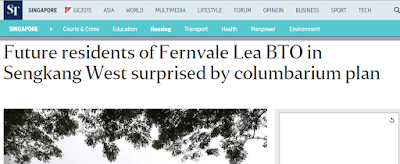
And thus the Sengkang Columbarium Saga happened, where a site next to a new housing estate was revealed to be won through tender by a private company that intended to build a columbarium facility there. When the news broke in late December, it understandably sent homebuyers into a frenzied state of anger and panic as they sought clarification and details.


Following this sizeable backlash, a dialogue session was held on 4 January 2015 between the affected homebuyers, the developer, the authorities (HDB and URA) and the MP of the constituency where assurances were made that HDB and URA would look into the concerns of these soon-to-be residents of the estate.


However, just two days later, on 6 January 2015, a joint press release was issued by the authorities to affirm that there would be no change to the situation and that the private company would be allowed to carry on with its plan for the site.


Over that same period, I had started looking closely at the company involved and its background, and discovered that the company had a very dubious layout. Using publicly available information from various sources, I pieced together the convoluted money trail and established just how far the rabbit hole went insofar as this company that won the tender was concerned. The article I prepared was then published on The Online Citizen on 9 January 2015.


And then subsequently, there was little activity on the mainstream media about this issue until it was announced in parliament by Dr Khaw Boon Wan on 29 January 2015 that the tender had been revoked.


My take is that the obvious negative outlook of the company on account of its layout and funding sources made it too unsavoury for the government to be involved with. I would even go far as to suggest that if not for my article spelling out just how questionable it was, I don't think the tender would have been revoked.

Truth Prevails
Now, the naysayers will naturally say that I am just full of it and that it was all just coincidence, not causation. Yes, that is surely a possibility. But, can you really say with definitive authority that the article did not force the government's hand in any way at all? 

The fact is many members of the mainstream media follow The Online Citizen (TOC) and the article was extensively shared on many other platforms. It is therefore hard to imagine that no decision-maker involved had been informed of the findings in my article.

And that's the point I'm driving at. As long as the possibility is there, we must continue to believe that our efforts to unearth the truth will bring about justice - even in a place as squeaky clean as Singapore. Instead of making blanket statements based on half-truths, choose an issue you believe in and tear it down with evidence and established facts.

If you're not good with words, you can still pass on the information to sites like TOC which are committed to getting reliable information out to the people. If that too isn't an option for you, then support those who are actually putting in the effort in seeking the truth. You've seen these people and have benefited from them, but have you actually recognised their efforts well?

Donate money, share their work and refer people who can contribute information to them - do something. Because citizen journalism is a movement, not just pockets of individuals. And everyone can be part of this movement towards truth.

Thursday, 20 March 2008

The Beginning Of Something...

After much deliberation over several months, I have decided to chronicle my thoughts as they emerge on this blog. I am, as yet, unsure of which direction the entries will take and will simply allow my train of thought to dictate its path.

Essentially, I hope that this blog will serve as a focal point for discussion on various issues; as a point of reference for those who wish to assess my capabilities and repertoire of knowledge; and ideally serve as a platform to reach out to the world - both in virtual space and in reality.

Do let me know if you like or dislike any of the material that I present as it will help me to evaluate what is interesting and what is not. Eventually, I hope that the feedback and responses that I gather from the process of maintaining this blog will aid me to produce even superior material - be it just these blog posts or any of my professional articles that are carried in print publications.

Prof Tom Kosnick of Stanford University recently remarked, "You have a gift as a writer, and a story to tell. Keep writing." - and I intend to do just that...

Thank you for visiting and I do hope you enjoy the read.