Showing posts with label author. Show all posts

Wednesday, 23 September 2015

Burning Down the Columbarium - The Power of Citizen Journalism

Anyone in Singapore knows that the business-government relationship is stronger than any marriage can ever be, and it is seldom the case that the government backs down on big-ticket deals related to infrastructure. For example, the casinos Integrated Resorts (IRs) faced a severe backlash from many Singaporeans who grew up with the notion that gambling was the devil's work. Since our government doesn't practice having a referendum on such major decisions, the deal was already signed even before the backlash took form. And in spite of everything that was said and done by the people of Singapore, the IRs became a reality and today, have become part and parcel of our life.

Having such strong bonds between business venture and government support, it has always traditionally been difficult to get the government to call off deals that appears to be to the people's detriment, primarily because it feels that it has made the best decision but also perhaps a little over-confidence that it wouldn't make major mistakes.

Citizen Journalism in Action
And thus the Sengkang Columbarium Saga happened, where a site next to a new housing estate was revealed to be won through tender by a private company that intended to build a columbarium facility there. When the news broke in late December, it understandably sent homebuyers into a frenzied state of anger and panic as they sought clarification and details.
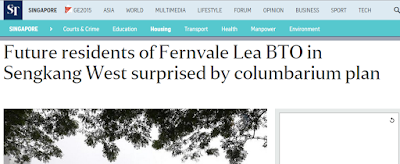


Following this sizeable backlash, a dialogue session was held on 4 January 2015 between the affected homebuyers, the developer, the authorities (HDB and URA) and the MP of the constituency where assurances were made that HDB and URA would look into the concerns of these soon-to-be residents of the estate.


However, just two days later, on 6 January 2015, a joint press release was issued by the authorities to affirm that there would be no change to the situation and that the private company would be allowed to carry on with its plan for the site.


Over that same period, I had started looking closely at the company involved and its background, and discovered that the company had a very dubious layout. Using publicly available information from various sources, I pieced together the convoluted money trail and established just how far the rabbit hole went insofar as this company that won the tender was concerned. The article I prepared was then published on The Online Citizen on 9 January 2015.


And then subsequently, there was little activity on the mainstream media about this issue until it was announced in parliament by Dr Khaw Boon Wan on 29 January 2015 that the tender had been revoked.


My take is that the obvious negative outlook of the company on account of its layout and funding sources made it too unsavoury for the government to be involved with. I would even go far as to suggest that if not for my article spelling out just how questionable it was, I don't think the tender would have been revoked.

Truth Prevails
Now, the naysayers will naturally say that I am just full of it and that it was all just coincidence, not causation. Yes, that is surely a possibility. But, can you really say with definitive authority that the article did not force the government's hand in any way at all? 

The fact is many members of the mainstream media follow The Online Citizen (TOC) and the article was extensively shared on many other platforms. It is therefore hard to imagine that no decision-maker involved had been informed of the findings in my article.

And that's the point I'm driving at. As long as the possibility is there, we must continue to believe that our efforts to unearth the truth will bring about justice - even in a place as squeaky clean as Singapore. Instead of making blanket statements based on half-truths, choose an issue you believe in and tear it down with evidence and established facts.

If you're not good with words, you can still pass on the information to sites like TOC which are committed to getting reliable information out to the people. If that too isn't an option for you, then support those who are actually putting in the effort in seeking the truth. You've seen these people and have benefited from them, but have you actually recognised their efforts well?

Donate money, share their work and refer people who can contribute information to them - do something. Because citizen journalism is a movement, not just pockets of individuals. And everyone can be part of this movement towards truth.

Wednesday, 11 December 2013

I Could Have Stopped The Riot

As many of you might know, I was an officer with the Singapore Police Force (SPF) for ten years and spent quite an amount of that time plying my trade in Little India. I left the force in 2005 for a several reasons, one of which was the way the SPF was turning out to be. With so much documentation and miscellaneous duties, policing became too much about following procedures rather than fighting crime - and worse, victims, perpetrators and every human being in the process became just another inanimate feature of each case.

When I first heard about rumours of a riot in Little India, I expected it to be an exaggeration of some accident scene because of the crowd that had gathered. But as the story unfolded, it quite sounded like mob mentality had resulted in wanton public violence.

However, as the details eventually become established, it looks more and more like a typical incident that spiralled out of control. In my time as a police officer attending cases in the vicinity of Little India, coming across accidents on a crowded Sunday evening is not something new - as is coming across disputes, thefts and even robberies. In this case, (possibly) careless driving led to a pedestrian (or disembarking passenger, as some eye witness testimonies suggest) being run over.

Naturally, as anyone who has been to Little India will tell you, a large crowd formed at the scene of the accident and fellow countrymen of the injured person started to panic and look at ways to extricate him from the situation. However, the bus driver (perhaps out of fear) chose to remain inside and not move the vehicle, which only served to exacerbate the situation. The distraught bystanders who were trying to help then became desperate and tried to break into the bus in order to move it (notice the lack of aggression or violence in the video below).


As one can expect, dustbins and random pieces of equipment would not be able to break the tempered glass of the windows or doors and so, the desperation merely escalated. Eventually, the Police arrived at the scene and (probably) projected aloofness, which gave the impression that the officers didn't care about the injured person or the despairing bystanders. By addressing the needs of the bus driver (who must have looked like the victim under the circumstances) the bystanders and others watching on the sidelines would have felt incredibly marginalised.

This is probably what infuriated others not directly involved with trying to rescue the injured person, and here is where the mob mentality truly set in, not any earlier. Having reached this tipping point, the bystanders would have reacted angrily and started attacking the Police vehicles and - by extension - the rescue vehicles (and personnel).

What I Would Have Done

After learning of these details I was actually surprised, because I have encountered similar elements and circumstances in other incidents while I was an officer myself. In fact I have brought things under control in similarly escalating situations before.

Basically, it is all about perception and a crowd of Indian workers expect sympathy and some concern for a fellow countryman who has been injured (or killed). Even with most of the situation already unfolding at the point when the Police arrived, I am fairly confident it could have been brought under control. I presume the situation to be a small crowd of distraught workers panicking and trying to gain access into the bus so that it can be moved to aid the rescue of the injured/dead person, surrounded by a larger crowd of onlookers (this has been corroborated by the description given in the letter from the Singapore High Commissioner to India).


Thus, upon reaching, the main persons to be addressed would have been the bus driver, the injured person and the group of distraught workers. Simply empathising with the distraught workers and letting them know that you are there to help the injured person would have actually calmed them down significantly and secured their cooperation (as opposed to unilaterally instructing them to stop their perceived aggression). By keeping the focus of this distraught group on rescuing the injured person (or his body), attention could have been diverted away from the driver inside the bus.

Next, getting the cooperation of the bus driver to move the bus or allow another officer to enter the bus to assist/direct the next course of action could have given control over to the officers at the scene since the crowd's objectives (gaining access to the bus to move it and aiding the injured person) would have been met. The watching bystanders would have had no reason to get angry and would have been satisfied that the authorities were being fair to the situation.

Depending on how heated the atmosphere was at the time, the bystanders could even have been co-opted to help console and reason with the distraught group, which would have diverted focus of this larger group onto the injured person and the affected workers rather than deliberate on the cause of the accident.

With the crowd thus under control and basically responsive to the police officers at the scene, medical aid could have been rendered without much interference and any hostility. Even with the injured person being pronounced dead, the crowd reaction could have been limited to just the grief by discussing the deceased's family instead of the cause of death (i.e. the accident) or about seeking justice. At this point, the bystanders could be asked to disperse or move back so that emergency vehicles and personnel can do the necessary. Once this space and distance has been created, the bus driver could be whisked away from the scene to further dissipate any tension at the point of accident.

All this could have been executed without the need for too many officers on duty and with no necessity for the SOC (i.e. 'riot police') being activated or for the need to recall all the off-duty officers of two police stations (which is what happened on Sunday night). While this is being portrayed as a major incident with all manner of pointless initiatives being rolled out as a knee-jerk reaction - not to mention the inevitable additional workload that awaits the already-overworked police officers of the area, in reality it all stems from a routine circumstance that has happened many, many times in various parts of Little India over the years.

This is why I am particularly saddened by this incident - an accident aftermath that was allowed to escalate into something so serious, and it is the first time since I left the SPF 8 years ago that I feel a tinge of regret - because had I not resigned, this riot may very well not even have happened.

_________________
Interestingly, I have covered the basics of this sort of situation in Chapter 3 (Handling Disputes) of my book which I published in 2008. If you're interested, feel free to click the button below to get it in ebook format.


Sunday, 24 August 2008

The 'Unofficial' Police Handbook

Ladies and Gentlemen, I present to you my first book - The 'Unofficial' Police Handbook. 3 years in the making - on top of my other projects, I have completed my 60-page insight on the elements of being a Police Officer. Meant to be both readable and informative to the layman whilst being exciting to fellow officers, I sincerely hope that it is accepted by one and all.

The E-Book preview contains the Preface, Chapter 1 and Chapter 9 (closing chapter) in full, so I hope that it gives a good overall indication of how good (or bad) the book is. After much research, I have decided to price the book between S$8 and S$10 - depending on the final cost of printing and marketing. However, I will be taking pre-orders for the book at S$7 a copy with the print release date set on (or before) 1st October 2008. Please drop me an email via the email link on the left or drop me an SMS at 90602206 to place your orders.

I encourage everyone to read the preview first and decide for yourself if it is worth your money to buy and read it. As those who know me would attest, it is not my style to ask anyone to 'support' this endeavour by buying the book for the sole reason of knowing me. I only ask the small favour of adding your opinion of the preview in the comments section of this entry - be they good or bad.


Front Cover


Back Cover


click icon for e-book preview